Alsace: Strasbourg, Colmar and the Half-Timbered Villages of the Wine Route
Four days in north-east France — canal-side Petite France, the painted houses of Colmar, and the Riesling vineyards in between.
📍 Alsace, France
Alsace is the slim sliver of France pressed against Germany on the country’s eastern flank, and it has, for most of its history, been pulled back and forth between the two — French until 1870, German until 1918, French again until 1940, German again until 1945, French ever since. The result is a region that looks, eats, drinks and (occasionally) speaks like nowhere else in France: half-timbered houses painted in pastel pinks and ochres, sausage and sauerkraut on every menu, dry Rieslings and aromatic Gewürztraminers in every cellar, and a quiet, polite, deeply orderly civic culture that owes more to Swabia than to the Côte d’Azur. It is one of the loveliest, most underrated regions in France.
Four days is the right length for a first trip — two days in Strasbourg, two days driving the Wine Route between Colmar and Mittelbergheim.
The setup
Fly into Strasbourg, or take the TGV from Paris (1 hour 50 minutes from Gare de l’Est). Stay in central Strasbourg for the first two nights, then move to Colmar (a 35-minute train south) for the next two. Hire a small car when you arrive in Colmar to drive the Wine Route — it’s the one part of the trip where the car earns its keep.
Day one: Strasbourg’s Old Town and the cathedral
Strasbourg is the capital of Alsace and the seat of the European Parliament — a city of about 280,000 people built on an island in the middle of the Ill river. The Old Town, the Grande Île, is a UNESCO World Heritage site, walkable in a long afternoon, and centred on one of the great Gothic cathedrals of Europe.
Walk to the Strasbourg Cathedral first. The west front is one of the most ornate in France — a 142-metre-high pink sandstone facade carved with a thousand statues, and a single asymmetric spire that was the tallest building in the world from 1647 until 1874. Inside, the famous astronomical clock (built 1842, still working) does its full performance at 12:30 p.m. with a parade of mechanical figures including the apostles and a rooster that flaps and crows. Get there at 12:15 to find a spot.
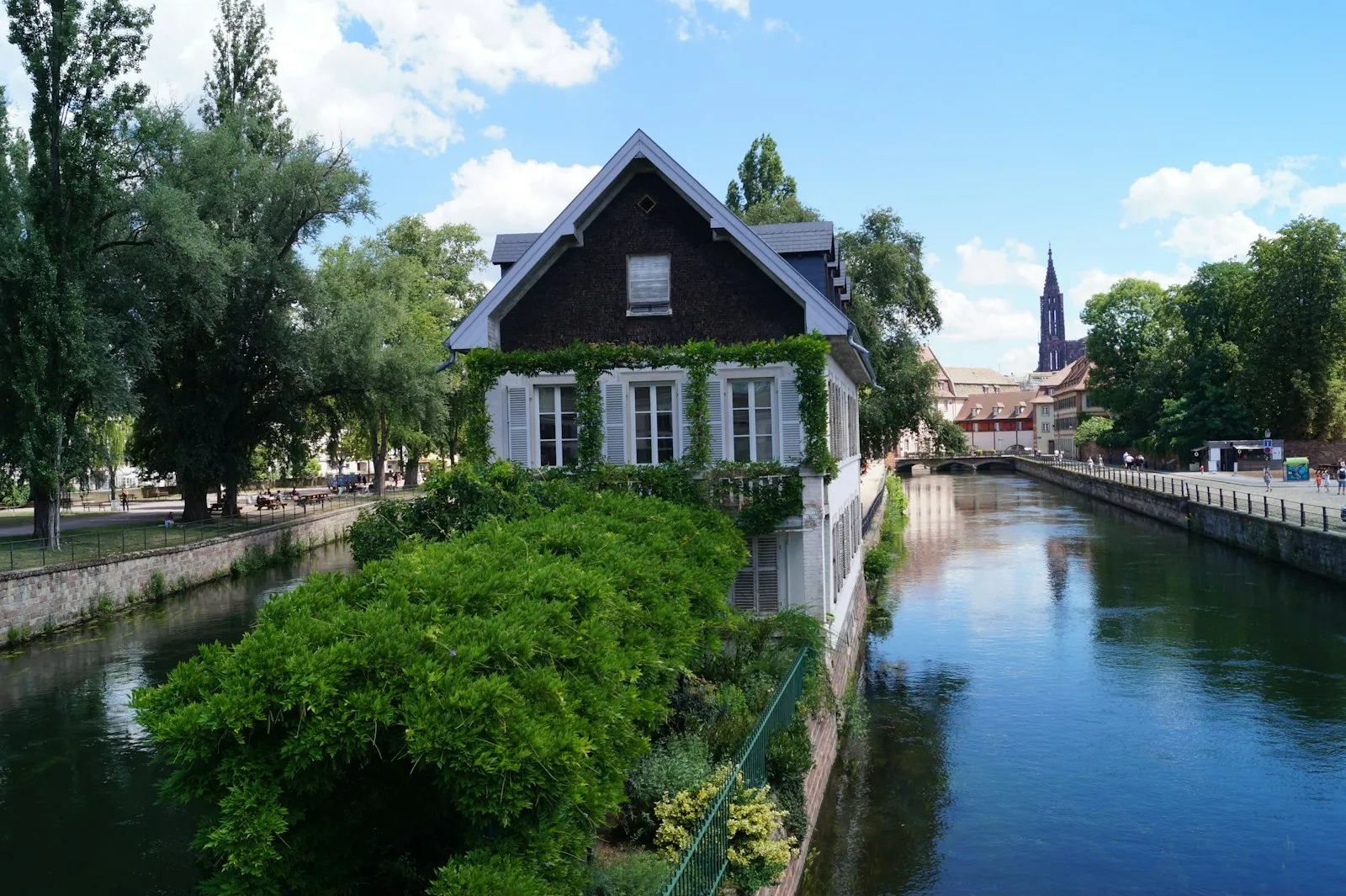
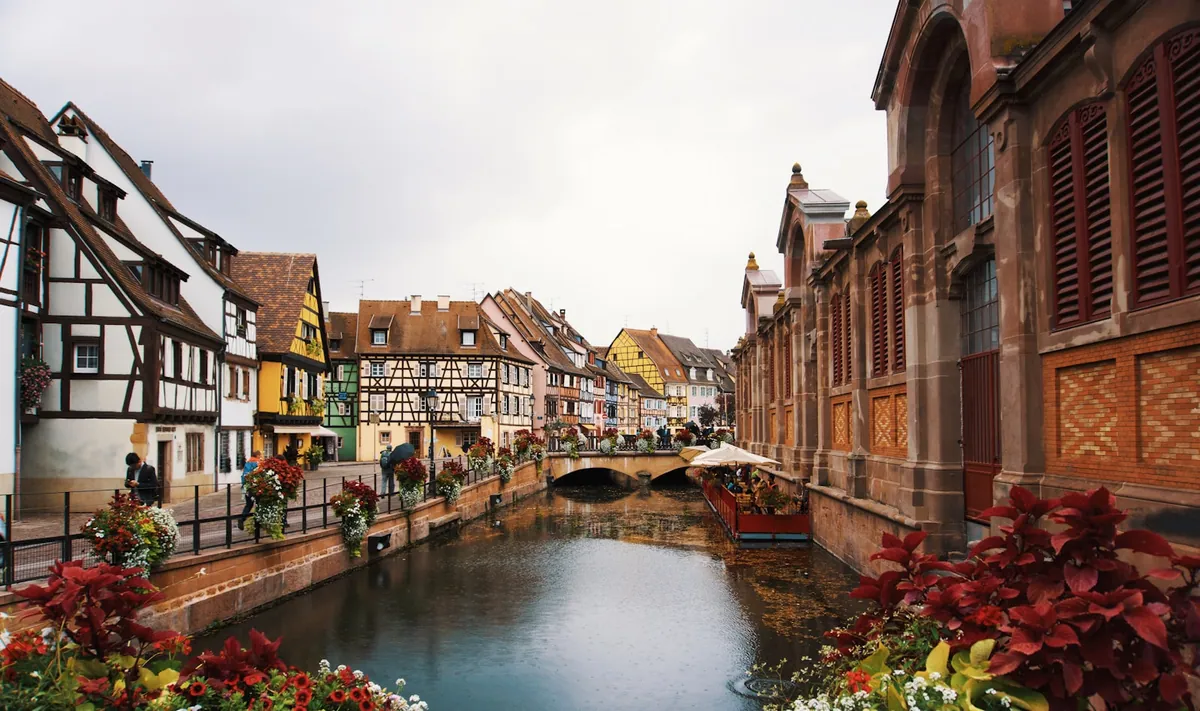
After the cathedral, walk the small streets of the Krutenau and Petite France quarters. Petite France is the postcard — a pocket of half-timbered, gabled, lopsided 16th- and 17th-century buildings on a small island, with canals on three sides and old wooden footbridges over them. The houses lean. The flower boxes overflow. The canal water reflects everything. It’s small enough to walk in twenty minutes and pretty enough that you’ll spend two hours.
For dinner, eat Alsatian. The local restaurant is the winstub — a half-tavern, half-bistro that serves choucroute (sauerkraut with sausages and pork), tarte flambée (a thin Alsatian flat-pizza with crème fraîche, onions, and bacon), and Riesling by the glass. Le Tire-Bouchon, Au Pont du Corbeau, and S’Burjerstuewel are reliable, traditional choices.
Day two: more Strasbourg, the European Quarter, the boats
Day two, take a boat tour. The Batorama river boats run an hour-long loop through the canals, past the Petite France, the Vauban barrage, the cathedral, and the European Quarter (the Council of Europe and European Parliament buildings). Cost: about €15. The boats are covered, audio-guided, and they give you a useful aerial view of the city’s layout.
In the afternoon, walk through the elegant 19th-century imperial German quarter — the area built when Strasbourg was capital of the Reichsland during the 1871–1918 German period — and visit the Palais Rohan complex of museums on Place du Château. The Decorative Arts and Fine Arts museums there are excellent and cover both French and German Alsatian artistic traditions.
End the day at one of the riverside cafes near the Pont Saint-Martin in Petite France for sunset.
Day three: Colmar
Train to Colmar. Colmar is smaller than Strasbourg (population 70,000), a 35-minute regional train ride south, and arguably more concentrated in its prettiness. The Old Town here is even smaller and more painted than Strasbourg’s — a cluster of half-timbered houses around the central Place de la Cathédrale, with a small canal-laced quarter called La Petite Venise in the south of the centre that has, with reason, become the most photographed neighbourhood in eastern France.
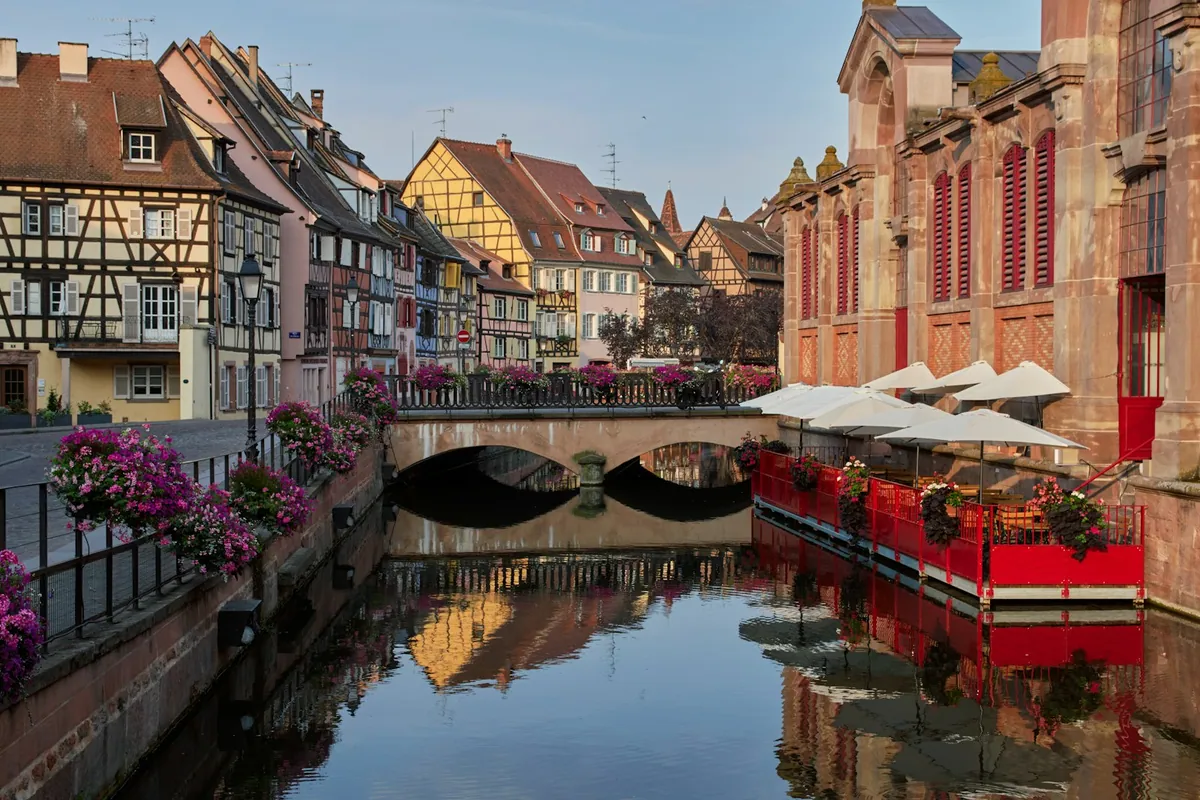
Walk a slow loop. La Petite Venise in the morning, before the bus tours arrive. The Pfister House (a brilliantly painted half-timbered facade, 1537). The Maison des Têtes (a 1609 facade with 105 sculpted heads). The cathedral. The covered market (Marché Couvert) for lunch — a beautiful 1865 iron-and-brick market hall with food stalls selling fresh produce, charcuterie, cheese, bread, and a few small bistro-style food counters that do excellent tartes flambées and quiches for €8.
In the afternoon, visit the Unterlinden Museum — Colmar’s headline cultural site. Housed in a 13th-century Dominican convent in the centre of town, the museum’s collection ranges from medieval to modern, but the headline piece is the Issenheim Altarpiece by Matthias Grünewald (c. 1515), one of the most extraordinary paintings of the Northern Renaissance. The polyptych is displayed in a way that lets you walk around it and see all four faces of its folding panels. Allow two hours.
For dinner, JY’S (one Michelin star, modern Alsatian) is the destination restaurant in Colmar; for a casual evening, any of the winstubs along Rue des Marchands.
Day four: the Wine Route
The Route des Vins d’Alsace is a 170-kilometre signposted driving route that runs north-to-south along the foothills of the Vosges, threading together about 70 wine villages between Marlenheim in the north and Thann in the south. You can drive the whole thing in a day, but the better plan is to drive a focused 30-kilometre section — say from Colmar north through Eguisheim, Riquewihr, Ribeauvillé, and Hunawihr — stopping for cellar tastings and lunches along the way.
Eguisheim and Riquewihr are the two famously perfect wine villages — concentric circles of half-timbered houses, decked with flower boxes, ringed by 13th-century walls, surrounded by vineyards. Both are touristy in midsummer; both are wonderful in shoulder season. Stop at one or two cellar doors per village. The wines are mostly Riesling, Gewürztraminer, Pinot Gris, Pinot Blanc, Sylvaner, and the late-harvest Vendanges Tardives. Most cellars charge €5–10 for a flight of four or five wines, with the cost refunded if you buy a bottle.
Eat lunch at one of the winstubs in Riquewihr or Ribeauvillé. The Alsatian wine country has a particular tradition called the marcaire menu — a long, multi-course farmer’s lunch with smoked pork, choucroute, and fresh cheese — that is exactly the right thing on a wine day.
End the day at Hunawihr, where the village stork sanctuary keeps a small population of the white storks that are the symbol of Alsace. Drive back to Colmar (or all the way to Strasbourg if you’re catching the morning TGV).
How nice are Alsatians?
Quietly, Germanically nice. The Alsatian temperament is a bit more reserved than the southern French — politer, slightly more formal, and once you’re welcomed, very warm. My four days included: a B&B owner in Colmar leave a small bottle of homemade plum schnapps in our room as a welcome gift; a winstub waiter in Strasbourg correct my pronunciation of choucroute three times until I got it right (with a smile); and a vineyard owner in Eguisheim refuse the tasting fee because “you walked here from the village, that is enough.” Alsatian friendliness is patient, deliberate, and genuine.
If you go
• Stay central in both Strasbourg and Colmar. The old towns are walkable and small. • Hire a car only for the Wine Route day. Don’t bother in Strasbourg. • Eat the local food. Choucroute, tarte flambée, and the various pork-and-cheese dishes are world-class on home turf. • Drink the Rieslings. The Alsatian dry Rieslings are some of the best white wines in France and are dramatically underpriced compared to similar quality from elsewhere. • Visit in late spring or early autumn for the best balance of weather and crowds. Christmas is a separate magical season — Strasbourg has one of the great Christmas markets in Europe.
Alsace is the most German-French place in France, and one of the prettiest and most rewarding regions in the country. Four days will give you the cathedrals, the painted houses, the canals, and a serious case of wanting to come back for the Christmas market season.